June 23, 2026
Published On:
By:
Jim Cashel
Primary care in developing countries has never had a stronger set of tools than it does today. Extraordinary advances in medicines, diagnostics, vaccines, and healthcare technologies are transforming what is possible. Diseases such as HIV, malaria, and tuberculosis — once considered nearly impossible to control in many low-resource settings — can now be effectively managed. Even more promising therapies and vaccines are rapidly emerging.
But these advances only matter if care can actually reach people.
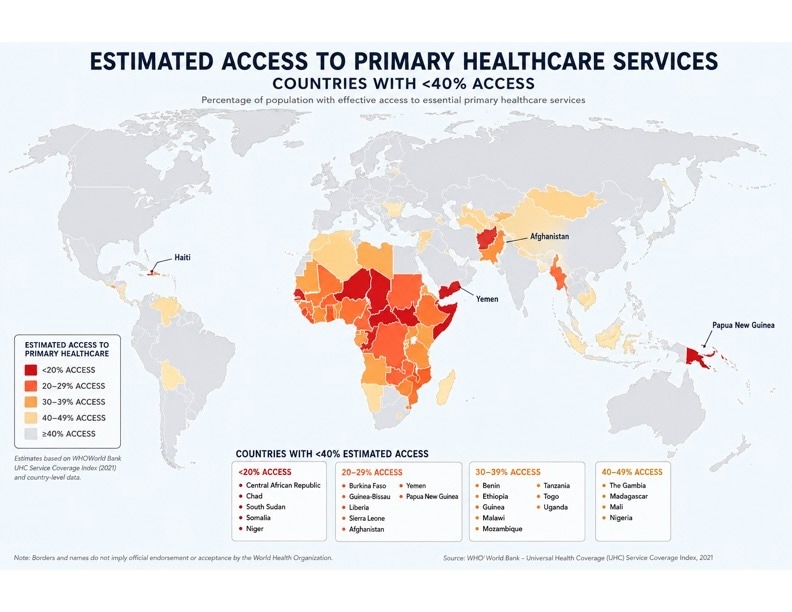
Today, most of the world has at least basic access to primary healthcare services. The major exception is Africa, where hundreds of millions of people still lack regular access to care because they live too far from a clinic or hospital. This is the “last mile” problem — though in reality it is often not a mile at all, but four, ten, or even twenty-five miles, far beyond what a mother can reasonably walk carrying a sick child.
One response would be to build more fixed clinics. But ministries of health across Africa are already overstretched financially and operationally, making large-scale construction and staffing of new facilities difficult.
Another approach is to deploy community health workers into underserved areas. This model is vastly better than no care at all and plays a vital role in many health systems. But community health workers have limits in both training and equipment, and more serious cases still require referral to clinics that may remain prohibitively distant.
A third solution — one pioneered by GAIA Global Health in Malawi — is the use of mobile medical teams. These teams typically include six trained medical professionals and support staff, equipped with essential medicines, diagnostics, and clinical equipment, operating recurring weekly primary care clinics in remote communities. The teams work in close integration with both the nearest fixed clinics (that often provide medicine and some staff) and community health workers (that provide initial outreach and referrals). GAIA currently operates 38 such mobile clinics, providing more than 250,000 patient visits each year.
The “last mile” challenge is one of the largest global health problems facing Africa — and arguably the world. But it is solvable. By bringing high-quality primary care directly to underserved communities, GAIA Global Health is helping demonstrate what that solution can look like.
.jpg)